Showing posts with label religion. Show all posts

Tuesday, October 4, 2016

DURGADEVI

DURGA DEVI

Sri Durgadevi is considered as Adi Parasakthi representing primordial Cosmic energy capable of  the three acts of creation, protection and destruction! She also stands for ‘ Maya' or illusion that envelops mankind. She is also called as ‘prakriti’ the consort of 'Purusha’. She is the power that moves the entire universe. While Purusha is static she is dynamic! He is potential energy while she is kinetic energy! She is the goddess of strength and power. She is the fierce form of Devi. According to Siva Purana Lord Siva invoked Durga from hi left half! Then  they created Siva Loka which is said to be Kasi or modern Varanasi. Later it is said that they created Vishnu and Brahma! According to another source Lalitha Maha Tripura Sundari emerged from the yagna conducted by Indra and other gods.

After Manmatha was reduced to ashes by the third eye of Siva, the Devas collected the ashes, shaped it like a man and took it to the Lord for his grace. When Siva looked at it, it came alive but instead of Manmatha a terrible demon Bhandasura was born! He immediately drained all the vitality of the Devas. Under the advice of Sage Narada, Indra performed penance and conducted a yagna when to the delight and surprise of Devas Lalitha Maha Tripura Sundari emerged in all her beauty and glory! She accepted Sri Kameswara as her spouse and was crowned. The Devas built Srinagara or Sripura on Mount Meru for her. They requested her to kill Bhandasura and save them! Later Devi leads her train and fights Bhandasura killing him finally.

Durgadevi is called by different names. She is Mahishasura Mardini, Kali, Renuka, Bhagavati, Bhavani, Ambika, Lalitha, Gowri, Jaya, Rajeswari and many others. Nine forms of Durgadevi (Nava Durgas) are 1 Skandamata 2 Kushmanda 3 Sailaputrl, 4 Kalaratri, 5 Brahmacharini, 6 Mahagowri, 7 Katyayani 8 Chandraghanta and 9 Siddhidatri. Durgadevi is the warrior manifestation of Adi Parasakthi! She is invincible. Lalitha is none other than the manifestation of Adi Parasakthi. According to Devi Mahatmya and Siva Purana Mahishasura, son of Rambha, a demon, tormented and vanquished the Devas. They appealed to Brahma, Vishnu, and Siva and to their astonishment saw immense light emerge from  Vishnu’s mouth! Similar rays joined this and to their amazement the beam of light transformed itself into a woman! She was Adi Parasakthi. The Devas bestowed all their divine weapons to her so that she could kill Mahishasura and restore peace.

Armed with the powerful divine weapons Durgadevi challenges the demons Bhandasura and Mahishasura and their armies. Sri Lalitha Sahasra Nama Stotra describes graphically how Devi fought with Bhandasura aided by Mantrini, Dandini and Varahi her second in command. Asiloma, Durdhura, attack Devi and she slays them all. Mahishasura pounces on  Devi as a buffalo. Devi binds him with ropes. He suddenly changes into a lion when Durgadevi cuts off his head with her sword and pins him down with arrows. The Asura soon transforms himself into an elephant and attacks her mount (vahana). Devi chops off  the trunk of the elephant! Once again the demon turns into a buffalo when Durgadevi flings her trident (trisula) and finally silences him for ever! Thus Durgadevi gets her name Mahishasura Mardini by killing the dreaded demon and establishing peace!

The weapons with which she armed herself not only decimate the terrible and cruel demons but signify peace and tranquility for the entire universe! Sudarsana Chakra offered by Vishnu stands for Dharma or righteousness. Conch by Varuna signifies Omkara or the Pranava. Bow and arrow presented by Surya destroys all difficulties and sorrows! The sword represents keen intellect and knowledge. The spear negates and destroys negative and evil thoughts. The club destroys the power of the enemies! Trident ( trisula) offered by Siva annihilates the three gunas,Satwa,Rajas, and Thamas! The thunderbolt presented by Indra stands for firmness of spirit. Lotus signifies awakening of spiritual consciousness! While being a terror to demons and all evil doers, Durgadevi is also the protector of the universe and humanity. The first three days of  Navarathri are dedicated to Durgadevi and the next three are for Lakshmi and the next three for Saraswathi. The eighth day of Navarathri is called Durgashtami, the day on which Mahishasura was killed! As this period falls during ‘ Saradrutu’ it is called ‘Saran Navaratri’. May Durgadevi bless us all!!

Tuesday, September 27, 2016

MAHALAYA PAKSHA

MAHALAYA PAKSHA

The fifteen days of the waning moon in the month of Bhadrapada as per the lunar calendar is called “ Mahalaya Paksha”. This period is also called as “Pitru Paksha”. It is in this period that all our ancestors and forefathers are remembered and offered ‘tharpanam’ to satisfy their souls. The ‘ amavasya’ or the new moon of the period is  as considered very sacred and called as 'Sarva Pitru amavasya’ when you can offer tharpanam to all our forefathers and ancestors. The autumnal equinox falls in this period as the Sun transits from the northern to the southern
hemisphere.

According to the legend, souls of the three preceding generations reside in ‘Pitru Loka’- the land of the disembodied souls of ancestors, between heaven and earth. Yama,the God of death and the ruler of that place takes the soul of the dying person from earth to 'pitru loka’. Only three generations of Pitrus are offered ‘ Sraddha’ rites. This period coincides with the entry of Sun into the 'Thula’ sign of the zodiac. It is believed that the Pitrus leave their abode in ‘Pitru Loka' and come down to reside in their descendants’ home for a month until the Sun enters the next sign of the zodiac Scorpio. All Hindus are expected to propitiate their ancestors and Pitrus during this Mahalaya Paksha without fail. Times have changed and today people have lost faith in performing funeral rites to their own parents and kith and kin.They have also forgotten to offer tharpanam to the three generations of forefathers every month on the New moon day! All such people can and should perform tharpanam during this special period to absolve themselves of the sin they have committed!

It is strongly believed among the Hindus that the souls of ancestors can never get salvation till their descendants offer the funeral rites and tharpanam. The eldest son of the family is the one authorized to perform funeral rites and tharpanam. A person without a son has no salvation say the Sasthras. “aputrasya gatir nasti”! The Garuda Purana and the Markandeya Purana affirm that if the Pitrus are satisfied, they bestow health, wealth and prosperity to their descendants and salvation to the performer! Most of the maladies that families suffer from can be traced to the nonperformance of these funeral rites and tharpanam! But these can be compensated during the fortnight of the Mahalaya Paksha. This period emphasizes the fact that ancestors,current generation and future generations are connected through blood! Our debt to them and parents and gurus is of utmost importance and has to be repaid properly with faith and devotion!

In the Bhagavad-Gita Lord Krishna points out to Arjuna the importance of Karma Yoga. Man cannot live even for a second without karma or action. He has to offer his gratitude through sacrifices. One of those sacrifices is ‘Pitru Yagna’ where he satisfies his parents and ancestors by offering tharpanam to them! We are indebted to the Devas, Pitrus, human beings,and even to the other creatures like animals, birds and insects. So we must clear our debt to them in one way or other. Our indebtedness to mother,however,can never be cleared!

There is an interesting story about the great warrior Karna of the Mahabharatha emphasizing the significance of offering tarpanam to  forefathers. When Karna’s soul was in heaven, he was offered gold and jewels for food. Surprised at this strange offering, Karna asked Indra why he was not given real food. Indra replied that Karna gave gold and jewels only for gifts and charity but no real food! Karna told Indra in reply that he had no information about his ancestors at that time. It is said that Karna was asked to come down to earth for fifteen days and perform  ‘Sraddha’. He came back to earth and offered tharpanams to his ancestors! This period coincides with  Mahalaya Paksha at the end of the month Bhadrapada! During this Paksha one can offer tharpanam to any deceased kith and kin like brother, sister, uncle, aunt, father in law, mother in law, cousin and even friend!  Let us not forget our parents and ancestors and invite their ire! Let us pay our deep debt of gratitude to them for the grace and prosperity bestowed on us!

Friday, September 9, 2016

GANAPATI TATWA

GANAPATI TATWA

Lord Ganapati is the darling of millions of people all over the world. He is mostly worshipped in India, Sri Lanka and Nepal. Devotion for the Lord extends  even to Buddhism and Jainism. He is Ganapati the Lord of the bhuta ganas surrounding Lord Siva. He is Vighneswara the Lord and destroyer of all obstacles. He is Ekadanta, the one with a single tusk. He is Gajanana, the elephant headed God. He is the patron god of arts and crafts and deva of intellect and wisdom. Ganapati  worship emerged during the Gupta period and in ‘Ganapathaya’in the 9th century Ganesha was worshipped as the supreme deity! The principal scriptures related to Ganesha are the Ganesha Purana, Mudgala Purana, and Ganapathi Atharva Sirsha.
Different and interesting stories relate to the origin of Ganapati. It is believed that goddess Parvati created him from out of clay for her protection. But Lord Siva in his anger beheaded him and replaced the elephant head in its place! According to another story Ganesha was created by Lord Siva's laughter! Ganapati is ‘ Omkararupa’ identical with Pranava,the primordial sound. Ganapathi AdharvaSirsha extols him as all in all-Brahma, Vishnu, Rudra, Indra, Agni, Vayu, Surya, and Chandra. He is the embodiment of entire creation. He is omnipresent. He is meditated as one with four arms. He holds the pasa in one hand, ankusa in another and exhibits varada and abhaya mudras in the other hands. He is red in color, has red clothes and red sandal paste all over his form.He has the mouse in his flag and rides on it He is called ‘ Lambodara and Mahodara’ because all the universes-cosmic eggs- brahmandas of the past, present and future are in him according to the Brahmanda Purana! He is the permanent resident of the first Mooladhara Chakra which is the starting point of Kundalini yoga. This Chakra is the principle on which the manifestation or outward expansion of primordial divine force rests! “twam mooladhara sthitosi nityam”---You continually dwell in the sacral plexus at the base of the spine.This Chakra holds, psupports,and guides all other Chakras thereby “ governing the forces that propel the wheel of life.”  He has the serpent king Vasuki around his neck and wears a serpent as a belt or the sacred thread! The arms of his form vary from14 to twenty! His vahana or mount varies as per his different incarnations.The mouse as vahana is found in five of his eight forms. As Vakrathunda he has the lion; as Vikata and Sesha the peacock; as Vighnaraja the divine serpent; as Mahotkata the lion; as Mayureswara the peacock; as Dhoomakethu the horse and as Gajanana the mouse are his vahanas. Brahmanda, Mudgala and Ganesha Puranas refer to the mouse as Ganesha's vahana.The mouse or mushika symbolizes tamoguna and desire. Ganesha controls and suppresses these qualities. the Sanskrit word mushika is derived from ‘mus’ meaning robbing or stealing! Rat, therefore is a destructive pest a type of vighna that has to be overcome. Ganesha, like the rat can penetrate into the most secret places! While Ganesha is considered as a celibate,he is also regarded as the husband of Siddhi,Buddhi and Riddhi. Buddhi symbolizes intelligence, wisdom or intellect while Siddhi denotes spiritual power. Riddhi represents Lakshmi or prosperity. Siva Purana states that Ganapati has two sons namely Kshema and Labha representing profit and prosperity!


No religious activity is conducted without propitiating Lord Ganapati! Even the gods fail when they neglect him. Lord Siva had to worship him before destroying the ,Tripuras’. Chandra,the moon god had to suffer as he made fun of the Lord’s tummy! Even Lord Krishna had to experience the effect of viewing the moon on Vinayaka chaturthi day! It was Lord Ganapati who outsmarted Ravana from taking away the ‘ atma linga’ for his mother! It was Lord Ganesha that took down the slokas of the epic Mahabharatha as sage Vedavyasa dictated to him!There is not a single village or town or city that has no temple for Lord Ganesha! May the Lord bless us for our well being and prosperity!

Monday, August 22, 2016

PARITHRANAYA SADdHUNAM.......

 “Parithranaya Sadhunam”………

Lord Vishnu killed Hiranyaksha and


Hiranyakasipu in Krutayuga and saved the earth from the demons! Later in Threthayuga Ravana and Kumbhakarna were got rid of during his incarnation as Sri Rama. Dwapara yuga was infested with a number of demons like kings Sisupala and Dantavaktra whose atrocities could not be endured by  mother earth. She appealed to the Lord who promised to incarnate soon and rid the world of these demons! Thus the Lord incarnated as Krishna  and chose Vasudeva and Devaki as his parents! It was Divine  conception for Devaki and the child Krishna an absolute incarnation of Vishnu-’ Swayam Bhagawan. Unlike the others, Krishna’s is a ‘ purnavatar’. Krishna was born on the eighth day of the waning moon of the month of Shravan as per the lunar calendar. The Lord was born in his original form, with four hands and the disc and the conch, in the prison cell but soon became a child!

Krishna was exceptionally beautiful. The word means ‘ black, dark,or dark blue. ‘ karshati iti krishna’-means one who attracts others. He is called  Govinda, finder of ‘go’-cows or Vedas, Gopala-protector of cows or souls. Like cowherds who protect the cows, the Lord protects the souls of the living beings! Krishna is described as an infant eating butter, as a young boy playing flute, as a  young man with Radha and other women and also as a mentor clearing the doubts of Arjuna in the Bhagavad-Gita!  Krishna is depicted as a God child, a prankster, a model lover, a Divine hero, and the Supreme being! Srimad Bhagavata glorifies Krishna’s sports as a child. He is all pervading in the Mahabharatha. Vishnu Purana and Harivamsa enumerate the greatness of the avatar. Whenever Dharma is endangered and adharma raises it's ugly head the Lord takes avatar to destroy evil and protect the good!

The first act of destroying evil commences with the killing of Putana, sent by Kamsa. Child Krishna sucks her life along with the poison from her breasts! A series of demons like Bakasura, Sakatasura and others are despatched to death playfully.Kamsa is killed next along with the wrestlers and the elephant that had run amuck. Later Krishna kills Sisupala and helps Bhima to kill Jarasandha who were terrorizing the people. Many other rakshasas were eliminated by Krishna as and when it became necessary. The most important role of Krishna in protecting Dharma commences during the Mahabharatha period. He becomes the friend, philosopher and guide to the Pandavas who were the embodiment of Dharma.It was Krishna who came to the rescue of Draupadi when
she was disrobed in the court in the presence of her husbands and the elders like Bhisma and Drona and others.

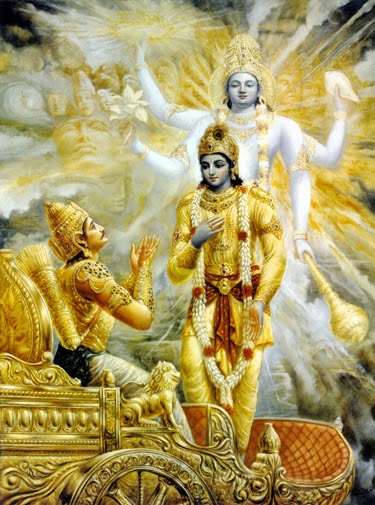
In the great Kurukshetra war that lasted for eighteen days, Krishna becomes ‘ parthasarathy ‘- driver of the chariot of Arjuna and leads him to victory! He dispels all the relevant doubts of Arjuna over killing his teachers, kith and kin. He counsels Arjuna to give up attachment and understand that the atma or soul is Indestructible, eternal and all pervading and manifest in every living creature.The paths of Karma, Bhakti and Jnana are explained to the Pandava warrior. In the forest Krishna saves Draupadi from the anger of sage Durvasa by just taking a morsel of food from her. Again and again he goads Arjuna to kill the Kauravas as they are the personification of evil and deserve to be killed mercilessly.

Krishna even goes as a messenger of peace to avoid war between the Kauravas and the Pandavas but as fate would have it they refuse to listen to him. Krishna plays a crucial role in killing Jayadratha who along with Karna and others killed Abhimanyu in the ‘Padma vyuha'. He brings him out of his hiding by covering the Sun with his Chakra when Arjuna beheads him with his arrow! He persuades Arjuna to kill unarmed Karna when his chariot sank into the earth by reminding the cruel manner by which Abhimanyu was killed. Finally he saves the foetus in the womb of Uttara from the terrible arrow of Aswatthama! Thus the only heir of the Pandavas, Parikshit, was left to rule after the all destructive war! Thus the Lord was always by the side of Dharma or righteousness, established it, and true to his word, destroyed the  evil and sinister forces!


Friday, August 19, 2016

A PEEP INTO THE GAYATRI MANTRA

A PEEP INTO THE GAYATRI MANTRA

The full moon day of the month of Sravana of the lunar calendar every year is celebrated as the day of ‘Upakarma’. It is the day when all the Brahmins put on the new sacred thread discarding the old one and perform GAYATRI chanting. They are expected to chant the mantra 108 times normally and 1008 times the next day! GAYATRI mantra is one of the oldest and most powerful of the mantras and is revered as ‘ maha mantra’. One who fixes and establishes it firmly in his mind is assured of a happy life. It protects the individual who chants it with faith and devotion and hence is called Gayatri! “ gayantam trayate iti Gayatri.”

Gayatri is called as the ‘ Vedamata’ of all the Vedas, Rig, Yajur, sama, and Atharvana Vedas. The mantra is composed of 24 syllables arranged in triplets of 8 syllables each. This metrical arrangement is called ‘tripathi’ and also Gayatri chandas. The mantra is from the Rig Veda (mandala 10:16:3). Om signifies the Pranava emanating from prana. The letter A indicates sound starting from the navel and emerging from the throat. The letter U represents it rolling over the tongue while M ends the sound on
the lips! The three avasthas of waking, dreaming, and  sleeping are indicated by the letters A U and M respectively! Pranava is thus the primordial sound symbolizing the universal Absolute.

In chanting the vyahrutis, ‘Bhu’, ‘Bhuvah’ and ‘Suvah’ the chanter meditates on the glory of God that illuminates the three worlds. ‘Savitur’ in the mantra is not the ordinary Sun but the ultimate light of wisdom. ‘Bhargo stands for illumination. The three vyahrutis represent the following as per the deeper meaning: ‘Bhu’ stands for earth, the past, morning, tamas,and the gross body. ‘Bhuvah’ represents the atmosphere, the present,  the noon, rajas, and the subtle body. ‘Suva’ shows space beyond the atmosphere, the future, evening, satwa, and causal body!

“ Gayatri is described as having five faces. The first is Om. The second is ‘Bhur Bhuvah Suva’. The third is ‘tat savitur varenyam’.The fourth face is ‘Bhargo devasya dhimahi’ The fifth is ‘Dhiyo yonah prachodayat’. The Five faces represent five pranas. Life forces protect the five pranas in man.When intelligence and intuition are developed, she is Gayatri.When life forces are protected she is the guardian deity Savitri. When speech is protected she is Saraswathi. Thus she is called ‘ sarvadevata swarupini’ the embodiment of all devas” explains Bhagawan Sri Satya Sai Baba (sss vol 16,06,March,1983)The meaning of the Gayatri mantra is “ we meditate on the adorable glory of the radiant Sun; may he inspire our intelligence”

Every brahmin bachelor and the family man, after his ‘upanayana’, has to perform ‘Sandhyavandanam’ thrice a day, in the morning, afternoon and the evening. But it is observed more in the breach than in the observance. It is pity that the brahmin community has lost its glory fascinated by the attraction of modern life, customs and manners. According to the  pramana it is a terrible sin not to know Sandhyavandanam or perform it daily as he is considered impure and unfit for any karma. Whatever karma he does will not bear any fruit. According to the pramana he shall suffer a punishment called ‘tamisra’ in the underworld or hell! He will be considered as a sudra during his lifetime! He will be reborn as a low animal. Our ancestors thus considered Gayatri in such great respect and esteem. The brahmin is called ‘ dwija' which means twice born. He gets his second birth only after Gayatri upadesa or Brahmopadesa by his father! Only then he is qualified to perform religious rituals and other karmas. Let us protect our dharma and follow the footsteps of our ancestors as far as possible!

Thursday, August 4, 2016

A FEW THOUGHTS ON SIN


A FEW THOUGHTS ON SIN

Christianity speaks about the first disobedience of man and the loss of paradise on account of his original sin. Milton glorified this through his epic poem ‘ Paradise Lost’ and later described in 'Paradise Regained’ man's redemption through Jesus! God created Adam and the Garden of Eden exclusively for his happiness.Adam created Eve the first woman from one of his ribs and they lived a happy life of bliss till Satan came into their life. Aggrieved and angry with God for throwing him down to Hell as he rebelled against him, Satan wanted to avenge God and as he could not approach God, decided to spoil the happiness of the original man, Adam! That was how he wanted to avenge God. He sneaked into the Garden of Eden,hoodwinking the guardian Angel. He entered into the carcase of a snake and approaching Eve praised her celestial beauty.He argued that she is fit for heaven and that Adam does not want her to ascend to heaven because of selfishness!  He persuaded her, by his wiles,to taste the forbidden fruit and Eve, in a moment of weakness, plucked the fruit and ate it to the dismay and shock of Adam! Thus man lost his pardise as shame and guilt overtook him! Naked until then, they covered themselves!

“ There is a charm about the forbidden that makes it unspeakably desirable” according to Mark Twain the renowned novelist.The desire to disobey is prominent when something is forbidden.Is there any person without sin? It is doubtful. Mae West says “ To err is human--but it feels divine!” The only sin is the sin of being born in the words of Samuel Beckett. When people wanted to stone a sinner, it was Jesus who remarked “ Let the one among you who is without sin be the first to cast a stone!” In short, it is rather impossible for man to lead a sinless life.

According to Swami Vivekananda, “ The Vedanta recognizes no sin. It recognizes error. And the greatest error, says the Vedanta, is to say that you are weak, that you are a sinner, a miserable creature and that you have no power and you cannot do this and that.” What is Sin? It is a sin “when the glory of God is not honored: when His holiness is not revered: when His greatness is not admired: when the Truth of God Is not sought: when the wisdom of God is not esteemed: when the commandments of God are not obeyed: when the wrath of God is not feared: when the grace of God is not cherished and when the person of God is not loved! (John Piper) These   sum up, in essence, the general way in which sins are committed.

While these acts are considered as individual sins, there are a few for which society is responsible! These are called social sins. They are: wealth without work: pleasure without conscience: knowledge without character: commerce without morality: science without humanity:worship without sacrifice: and politics without principles! Present day society is definitely guilty of all the sins stated above! People earn money without any work and indulge in pleasures without any conscientious scruples! Knowledgeable people have no character. Morality is significantly absent in modern commerce and trade. Humanity is endangered by the tremendous advancement of science and technology and nuclear devices that may go off at any time! Worship too has become more commercial and there is no sacrifice at all.

Pride, arrogance and indulging in lies are denounced as sins. According to John Maxwell,  “There are two kinds of pride both good and bad. Good pride represents our dignity and self respect. Bad pride is the deadly sin of superiority that reeks of conceit, and ignorance.”Sin has many tools, but a lie is the handle which fits them all! says Edmund Burke!The inner enemies of man compel him to commit sin. It is a formidable task to withstand their pressure.We find many in the world who live comfortably and thrive on their sin! “ Some rise by sin and some by virtue fall” says Shakespeare! But eventually it is the sinner who comes to nothing.The rise of the sinner may be meteoric but he has to fall and meet his doom finally! Let us be aware of the pitfalls of sin and avoid them as far as possible!


Thursday, July 21, 2016

PURUSHASUKTAM---MEANING!

PURUSHA SUKTAM -- MEANING

Purusha Sukta is a hymn of the Rig Veda, dedicated to the Cosmic Being by the rare insight of the great seer Narayana Rishi. There are a few different versions in the other Vedas also. The sukta glorifies the Lord of the yagna who protects not only human beings but the quadrupeds. Purusha is both immanent in the manifested world and transcends it. Purusha is endowed with thousands of heads and feet. After filling the entire universe, He rose ten inches above the earth. He embodies the past, present and the future and is the cause for immortality since he transcends the inert world. All creation and what is perceived in this world is just one fourth part of God! The other three fourths are in the eternal! sky. While this is beyond the perception of the mundane world, the other one fourth has emerged as the world we see!

The YAGNA--  From this original Purusha, macrocosm ( Brahmanda) came into existence. Along with it  the Cosmic person emerged. He created the earth first and the bodies of  all creatures. Meanwhile the Devas desired to perform a yagna for the welfare of  the world, and not having anything to offer in the sacrificial fire, finally sacrificed God himself! Entire Nature played a distinctive  part in the performance of the yagna.Spring season was the ghee, summer the firewood, and rainy season the naivedya. The sides of the homa kunda were formed by the earth and the other elements, day and night to drive away evil forces. Twigs (samidas) for the sacred fire were the five jnanendriyas, five karmendriyas, five pranas, mind,intellect, chitta, and ahankara or ego! Creator Brahma became the sacrificial animal and the yagna began. Brahma rose as the yagna purusha as the sages,Devas and others chanted Vedic mantras.

THE CREATION: As the yagna purusha, Brahma created curd, ghee, all birds, the deer, wild animals, and cattle. From this sacrifice emerged all the four Veda mantras including the famous Gayatri and others of different chanda (prosody) From the same yagna emerged horses with single layer of teeth and animals with two layers of teeth like cows, buffalos, goats. Before man emerged, they imagined what form should be given to him. They thought about what parts of this Virat Purusha should correspond to the face, shoulders, thighs, and feet of the different classes of human beings. The class of Brahamana formed the face of this Virat Purusha representing thinking and discriminating power. Kshatriyas that save the society from enemies became the strong and powerful shoulders of the Purusha. Vaisyas who increase the wealth of the nation formed the thighs while Sudras formed the feet that aided the movement of the Viratpurusha! From the manas of the great form Chandra (Moon) was born. From his eyes the Sun (Surya), from the face Indra king of God's, and Fire the god of fire, and from his prana or breath Vayu (Wind) were born respectively! From his navel the Sky, from the head the heaven or Swarga, from the feet the Earth, from the ears directions like the East came into existence

REALIZATION:  I have realized and understood the powerful self sacrificing Bhagawan, effulgent like the Sun and far distant from the darkness of ajnana. He has created all the forms in the universe and given them names also actively! The creator Brahma first knew about this Purusha. He told about this knowledge to Indra who realized the Paramatma in all the four directions. One who understands the omnipresence of Paramatma shall be emancipated. There is no other way to achieve immortality! The Devas were selfless in performing the Yagna and followed Dharma. By following the path of Dharma and Thyaga or sacrifice one can reach the higher worlds. This world emerged from the essence of water and earth. Brahma was the offspring of the Paramatma. He is immanent in the creator Brahma. This Omnipresent form of the creator Brahma came out at the beginning of creation. I have realizes this  Paramatma! One who has this realization attains salvation here even in this birth itself!

           Paramatma is very active and in spite of birthlessness, is born in this world in many forms! Great Maharshi or sages
          have recognized His real Nature! That is why persons like Brahma desire to have the position of sages like Marichi
          and others! My pranams to the One who is the Radiance, mentor, and preceded all the Devas! The Devas have
          announced that they will be favourable to those who try to realize the Paramatma in the manner described above! O
          Paramatma! the very form of modesty Hri Devi and the source of all wealth and prosperity Lakshmi Devi are your
          consorts! Day and Night are your two sides! The stars are your holy form! only! Aswini devas are your blooming face!
          Kindly shower your Grace on us and grant all we desire! Grant us the pleasures of the earth and heaven!


Monday, July 11, 2016

KARMA---NO ESCAPE

KARMA--NO ESCAPE

Every action has an equivalent and opposite reaction said Newton! This statement is  perfectly true in religion as it is in science. For every cause there must be an effect. In religious parlance we call action as karma. It is impossible for man to exist without action or karma. Physically or mentally he is ever active. He is involved in some physical work or mentally worried about some problem or other entangled in the cycle of birth and death. Usually we do some work expecting a result. The result may be either good or bad. But the result has to be there. Now the question is whether you can perform a work but prevent the result yourself. Whether you like it or not there is bound to be the result for any action done by the individual. There cannot be two opinions on this point. Whether we take a laxative or some pill knowingly or unknowingly the effect is surely to be felt. In other words, there is no escape from the result of our actions or karma.

“ avsya manubhoktavyam krutham karma subhaa subham-- The effects of action, good or bad, have to be experienced  definitely say our Sastras.The distinctive features of Hinduism are the belief in rebirth and the theory of karma! Unlike Islam and Christianity that accept unmerited suffering as the will of God, Hinduism explains it as the result of one’s actions in his previous birth.The reason why people are born dumb, deaf, blind, lame and other disabilities is to be found in their actions in their previous birth! God can never be partial to a few and impartial to others. All are his children and his Grace is showered on all like the light of the Sun. He allows the human beings to suffer or enjoy according to their bad and good deeds respectively. Lord Krishna explains the invincibility of karma to Arjuna in His discourse on Karma Yoga in the Bhagavad-Gita.

Even as the child is born, karma is in action! Birth In a rich, middle class or poor family and various other factors depend on this factor. This is called PRARABDHA KARMA---karma already yielding results.During his lifetime,man accumulates karma by his actions good or bad. This is similar to a fixed deposit from which you can draw whenever you require. This type is called SANCHITA KARMA-- cumulative deposit.This karma is the basis for man’s future course of life and what happens to him at every stage of life. This is called AGAMI KARMA--that which is to come. Thus man’s existence is inextricably interfused  with his actions in this and his previous births! The accumulated karma is so huge and colossal that it can not be exhausted and experienced in a single birth. Hence man has to take countless births to experience the effects of his actions. After he suffers and enjoys and comes to the end of his experiences, after innumerable births and deaths, he can expect salvation or mukti. Papa and punya--- sinful and good deeds have to be suffered and enjoyed respectively and separately. They can not  be exchanged. After suffering in hell and enjoying in heaven,on account of papa and punya, the jeeva has to descend to earth again! “ kshine punye martya loke visanthi” On no account can one’s sinful deeds be cancelled by his good deeds or punya! One should not be under the delusion that by charitable acts and other good deeds his sins will be cancelled!

“ The consequence of karma can be wiped out only through karma, as a thorn can be removed only by means of another”. Says Bhagawan Sri Satya Sai Baba.Jaya and Vijaya, the guards at the threshold of Vakunta, the abode of Lord Vishnu prevented the great sages Sanaka, Sanandana and others from entering. Angered at this, the sages cursed them to be born as mortals on earth.Taking pity on them, the Lord gave them a choice,either to have seven births as friends of the Lord or three births as inveterate enemies of the Lord. Jaya And Vijaya chose to be the enemies and desired to return to Vakunta as early as possible. Thus their action resulted in their birth as Hiranyaksha and Hiranyakasipu in the krutha yuga, Ravana and Kumbhakarna in Treta yuga and Sisupala and Dantavaktra in DwaparaYuga! They tormented the world and even the  heavens. Devas had to rush to Lord Vishnu for relief. Lord Vishnu himself had to take avatar to kill these demons. Hiranyaksha was killed during the Varahavatar,(wild boar) and Hiranyakasipu was killed during that Narasimhavatar (man lion).

To kill Ravana, the Lord came down as Sri Rama in Treta yuga, and was the embodiment of Dharma or righteousness! He established Ramarajya and became the role model for humanity! Again in Dwapara yuga the Lord took avatar as Krishna the son of Devaki and Vasudeva. He killed many demons in his childhood including his maternal uncle Kamsa. He killed Sisupala and others and was responsible for the annihilation of the Kauravas who were personification of evil, greediness and arrogance. Thus killed in their three births as enemies of the Lord, Jaya and Vijaya returned to their abode and duty at Vakunta! For a small indiscreet act in stopping the sages they were cursed and had to suffer untold miseries on earth! None can escape the effect of karma.Is it possible to overcome the effects of karma? Yes. It is possible under extraordinary circumstances! One should be a passionate and ardent devotee of God totally surrendering himself to God’s will. Only great bhaktas like the child devotees Dhruva, Prahlada and Markandeya had that Divine Grace that totally destroyed their karma and gave them emancipation!


Monday, April 18, 2016

THE MESSAGE OF MAHAVIRA


Buddhism and Jainism, two of the oldest religions of India, had their prime time in ancient India. During the days of Asoka we are told that he sent missionaries to Lanka for the propagation of Buddhism! He was sorry for the terrible killings during the Kalinga war which converted him into a Buddhist. Jainism too had its sway in India for a short while and slowly it lost its hold on the majority of the people in the country. What is the reason for the decline of Buddhism and Jainism in India? It is because of the rise of Brahmanism and a revival of the teachings of the Vedas and the Upanishads spearheaded by the three acharyas, Sankara, Ramanuja, and Madhwa. These three were the pillars of the period and rejected the principles of Buddhism and established the primacy of the Brahman and the theory of the indestructible Soul. The Bhakthi movement in the North led by great saints and the movement of the Azwars and Nayanmars gave a death blow to Buddhism and jainism .
          Vardhamana Mahavira, the embodiment of compassion for every living being, has great relevance today in a world  plagued by terrorism, violence, envy, fraud, intolerance  and every kind of misery. He was the24th and last jain Tirthankara. He is considered as the founder of Jainism but the Jain tradition recognizes his predecessors. His date of Birth is either 599BC or480 BC. His dynasty is said to be that of Ikshvaku—that of Sri Rama of the Ramayana. Born to the couple, Siddharta( father) and Trishala (mother) in Vaishali on Chaitra suddha trayodasi, he left  his home at the age of 30 in search of spiritual awakening. Like the great Gautama Buddha who left his home in search of peace, Mahavira abandonrd all worldly attachments including clothes and became a jain monk. Spiritual sadhana cannot be attained by magic and Mahavira  involved himself in severe meditation and  intense penance for twelve and half years after which he became “ KEVALI”----Omniscient.
            This did not satisfy Mahavira. He had to spread his message all over the world. The next 30years were spent in spreading the message of Jain philosophy throughout South Asia.  The teachings of Mahivira are centered on the observance of the vows ahimsa (non injury), satya (truth) astheya ( non thieving), Brahmacharya (chastity) and Aparigraha (non attachment). These qualities are sinequo non for the elevation of the quality of life. Jain Agamas were compiled by his chief disciple Gautama Swami but most of them are not available today. It is believed that  Mahavira attained moksha--- liberation from the cycle of birth and death at the age of 72.  He was called Mahavira because of the acts of bravery he performed during his childhood. He was awarded the title ‘ JINA’ – the victor or conqueror of inner enemies such as attachment, pride, and greed.
             Mahavira’s philosophy has eight cardinal, three metaphysical ( dravya, jiva,and ajiva) and five ethical principles. The objective of Mahavira is to ennoble the quality of life. According to Mahavira ‘an individual or society should exercise self restraint to achieve social peace, security and an enlightened society.’   A few quotes from Mahavira:  “Every soul is independent. None depends on another. Have compassion on all living beings. Hatred leads to destruction. Do not injure,abuse, oppress, enslave, insult, torment, torture, or kill any creature, or living being. Fight with yourself, why fight with external foes? He who conquers himself through himself will obtain happiness. A man is seated on top of a tree in the midst of a burning forest. He sees all living beings perish. But he does not realize that the same fate is soon to overtake him also. That man is a fool. Mahavir’s great message to mankind was that birth is nothing,  that caste is nothing,  and that Karma is everything and on the destruction of karma future happiness depends!!This is in striking resemblance to the Karma theory of Hinduism!  It is only after man exhausts the experiences of his Karma in the past he gets emancipation or mukti!  Let us remember the teachings of  Mahavira and try to follow at least a fraction of them for our salvation!!

Thursday, October 22, 2015

THE STORY BEHIND VIJAYA DASAMI


VIJAYA is one of the ten names of Arjuna the famous Pandava warrior of the epic Mahabhararatha! The other names of Arjuna are Phalguna, Partha Kiriti, Swethavahana, Bibhatsa, Krishna, Savya sachi, and Dhananjaya! The tenth day of the waxing moon ( sukla paksha) of the month of Aswiyuja has a winning connection with Arjuna!This is not very well known to  many people. The word Vijaya denotes victory or success. Thus this Dasami is considered the best and the most auspicious day for commencing any type of activity. What is the story in Mahabharatha behind this VIJAYADASAMI?
       It was the period of ‘ajnathavasa’, (living incognito) for the Pandavas. They had disguised themselves and served in the palace of King Virata. Yudhishtira was the royal adviser to the king. Bhima was the chief chef in the royal kitchen. Arjuna, as Bruhannala, served as the dance master to the princess UTTARA and assisted the queen. Nakula and Sahadeva  looked  after the herds of cattle and others. Days went on smoothly for almost the end of the ajnathavasa.
        Duryodhana and the Kauravas were on tenterhooks. They wanted to find out the whereabouts of the Pandavas. If within the end of this period the Pandavas are found out, they have to go into the forest for 12 more years and one more year of living incognito. Through spies and much effort they knew that the Pandavas,  in disguise, were with King Virata. Duryodhana was exuberant with the thought of sending back the Pandavas for another term of forest life. Plans were contemplated to draw the Pandavas  out  as early as possible. It was suggested that the Kaurava forces should attack northern part and steal away the herds of cattle! Pandavas would surely come out of their hiding to help the king. That will spell doom for Pandavas as they have to go to the forest once again! That was the grand plan of the Kauravas! Orders were  passed  and  Kauava forces invaded the northern part, rounded up the herds and seized them! This incident is called UTTHARA GOGRAHANA
        There was alarm in King Virata’s court. This was totally a bolt from the blue. Prince Utthara Kumara was young and inexperienced. Yudhishtira, being the advisor  suggested  that  if permission is granted he and his brothers can help in defeating the Kauravas  and bring back the herds of cattle. The Prince was in a dilemma. Prince UTTHARA KUMARA volunteered to go to the battle  field  and fight but the king was hesitant. The Prince insisted  on fighting the kaurava forces but he had no competent  sarathi—driver of chariot! Thereupon, Arjuna   offered  himself to be the driver for prince UTTHARA KUMARA. The prince was not impressed as Bruhannala was only a dance master for his sister, Uttara. But Bruhannala pointed out that he was once the driver of the chariot of Arjuna the pandava warrior. Finally the prince readied himself to fight the Kauravas and left for the battlefield  with Arjuna driving the chariot!
           The  moment  the prince saw the mighty army of the kauravas , he began to tremble with fear. He could not stand. Suddenly he threw down his bow and arrows and asked Arjuna to stop the chariot. Before Arjuna could do so, the prince jumped down and began running! Arjuna brought back the running prince, encouraged him, and directed him to drive the chariot. He said that he would fight the Kauravas. Then Arjuna went to the “SEMI VRUKSHA” the tree where the Pandavas had hidden all their weapons before they went to king Virata. He bowed down to the tree, retrieved his great bow Gandiva and the quiver of arrows even as the prince was bewildered! Arjuna then fought the Kauravas and with his “ sammohanasthra” made all kaurava forces faint!  All the herds of cattle were brought back to their original Place! That day of the victory of Arjuna over the Kaurava forces happened to be the ‘dasami’—tenth day of the waxing moon of the month of Aswiyuja! It was the Day of Victory for VIJAYA   ie Arjuna! Hence the day is called ‘ Vijaya Dasami---the day of victory not only for Arjuna  but for all!!
           Different stories are popular in different states in India! VIJAYA DASAMI Is considered as the celebration of the day of Victory when Adi Parashakti, as DURGA killed Mahishasura the tormentor of Devas  After killing him on the 8th day of Navarathri she sits in durbar—in court with all majesty and grandeur! That is the significance of ‘ koluvu’ in South India! Almost every house has a simple or grand koluvu to signify the end of EVIL and the rule of GOOD!!